
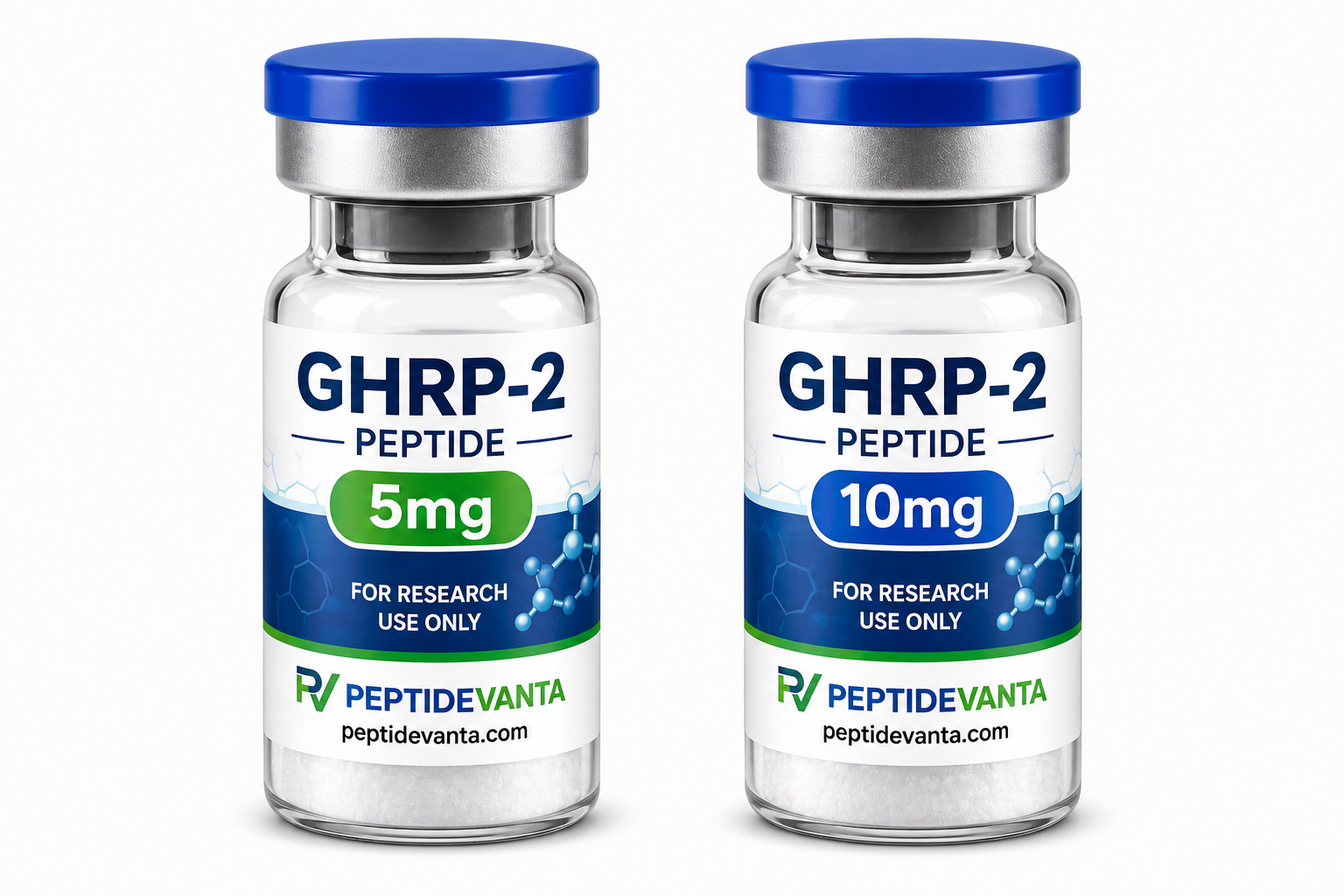
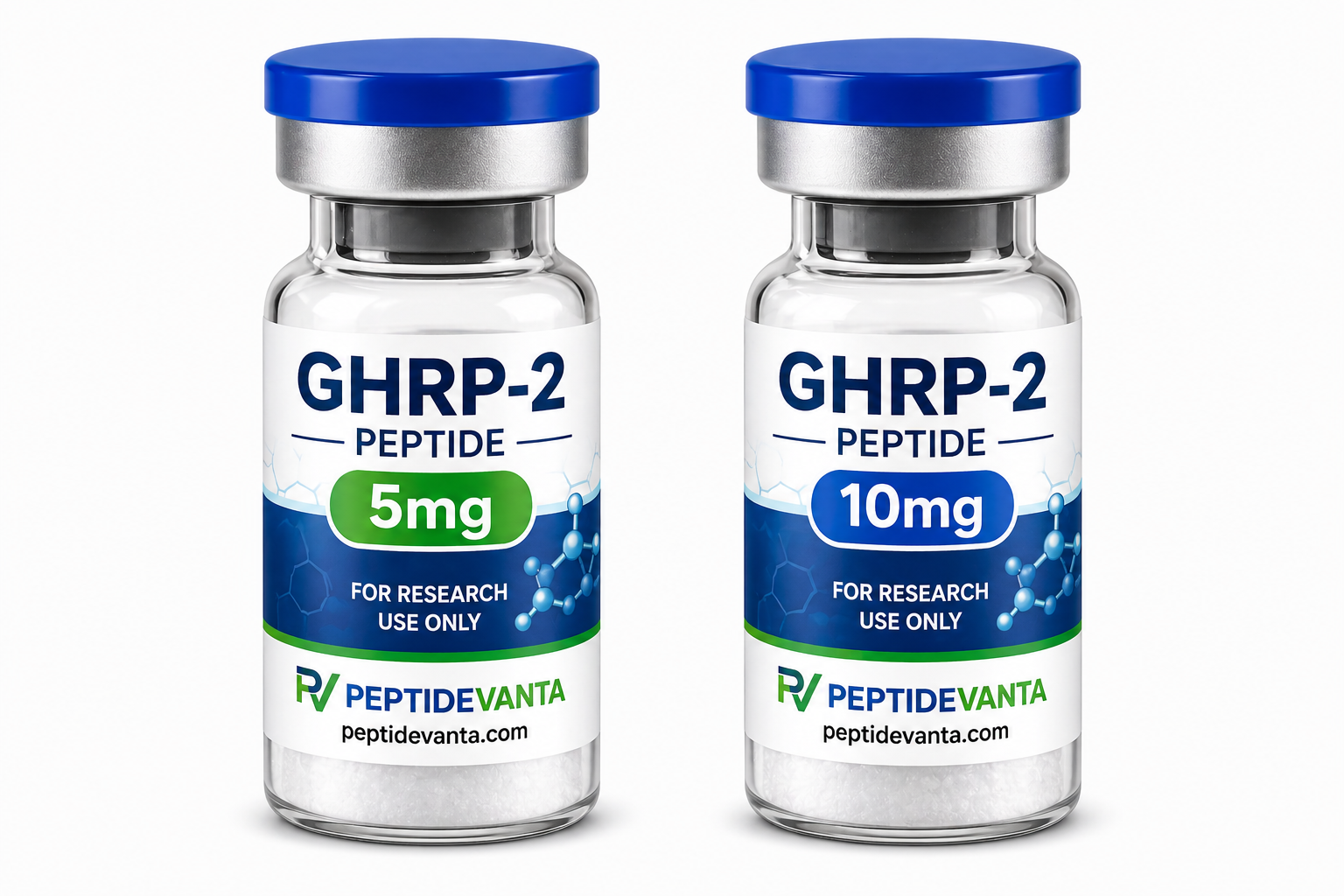
GHRP-2 (Pralmorelin) - Potent Growth Hormone Releasing Peptide-2

★★★★★
4.6 out of 5 (2,154 verified reviews)
$34.99 - $64.99

GHRP-2 (Pralmorelin) is a synthetic hexapeptide belonging to the growth hormone releasing peptide (GHRP) family, with the amino acid sequence D-Ala-D-2-Nal-Ala-Trp-D-Phe-Lys-NH2. Developed in the 1990s as part of efforts to create more potent and selective growth hormone secretagogues, GHRP-2 has become a widely used reference compound in GH research. Known for its high potency and efficacy, GHRP-2 is a valuable research tool for studying growth hormone (GH) secretagogue receptor (GHSR-1a) activation and downstream signaling pathways. With a well-characterized pharmacological profile that includes robust GH stimulation with moderate effects on cortisol and prolactin, GHRP-2 occupies an important position between the highly selective Ipamorelin and the more broadly active Hexarelin. The peptide is widely used in comparative GHRP studies, pituitary function research, and investigations of the neuroendocrine regulation of GH secretion. PeptideVanta offers premium-grade GHRP-2 with verified 99%+ purity through third-party HPLC testing.

✔ 99%+ purity (HPLC verified)
✔ Third-party tested with COA
✔ Lyophilized powder in sterile vials
✔ Potent GHRP with high receptor affinity
✔ Well-characterized GHSR-1a agonist
✔ Discreet worldwide shipping

Select Dosage / Strength
5mg - $34.99
10mg - $64.99
Quantity (10 Vials)
$34.99
🔬 Lab Tested🚚 Worldwide Shipping💎 99%+ Purity🔒 Secure Checkout⚡ Potent GHRP

GHRP-2 for Research: Complete Scientific Overview

GHRP-2 (Pralmorelin) is a synthetic hexapeptide with the amino acid sequence D-Ala-D-2-Nal-Ala-Trp-D-Phe-Lys-NH2. Developed as part of the second generation of growth hormone releasing peptides following the discovery of GHRP-6, GHRP-2 was designed to improve potency and selectivity while maintaining favorable pharmacokinetic properties. The peptide contains multiple D-amino acids (D-Ala, D-2-Nal, D-Phe) that confer resistance to proteolytic degradation, enhancing in vivo stability. As a potent agonist at the growth hormone secretagogue receptor (GHSR-1a), GHRP-2 has been extensively characterized in comparative pharmacology studies alongside other GHRPs including Hexarelin, GHRP-6, and Ipamorelin. The peptide's well-defined pharmacological profile—characterized by robust GH stimulation with moderate effects on cortisol and prolactin—has made it a valuable reference compound in GH research. GHRP-2 has been used in numerous preclinical studies investigating the GH/IGF-1 axis, pituitary function, and the neuroendocrine regulation of growth hormone secretion.

Mechanism of Action

GHRP-2 exerts its biological effects through specific activation of the GHSR-1a receptor via multiple signaling pathways:

  • GHSR-1a Activation (Primary Mechanism): GHRP-2 is a high-affinity agonist at the growth hormone secretagogue receptor (GHSR-1a), a G-protein coupled receptor primarily expressed in the pituitary gland and hypothalamus. The receptor signals through the Gq/11 pathway, leading to phospholipase C activation, inositol trisphosphate (IP3) production, intracellular calcium mobilization, and subsequent GH release from somatotroph cells. Binding affinity (Ki) is in the low nanomolar range, comparable to Hexarelin and GHRP-6.
  • Potent GH Stimulation: GHRP-2 triggers robust, dose-dependent release of endogenous growth hormone from pituitary somatotrophs. The EC50 for GH release is approximately 0.5-1 nM in vitro, making GHRP-2 one of the most potent GHRPs available for research, second only to Hexarelin.
  • Cortisol and Prolactin Effects (Intermediate Profile): GHRP-2 produces moderate stimulation of cortisol, prolactin, and ACTH release. This effect is less pronounced than that observed with Hexarelin but more significant than with GHRP-6. This intermediate profile provides a useful research tool for studying the differential effects of GHSR activation on pituitary hormone secretion.
  • Minimal Appetite Stimulation: Unlike GHRP-6, which strongly activates appetite pathways through ghrelin receptor signaling, GHRP-2 has significantly lower appetite-stimulating effects. This selectivity makes GHRP-2 more suitable for studies focused on GH secretion without the confounding variable of appetite modulation.
  • Pulsatile GH Release: When administered in appropriate research protocols, GHRP-2 induces pulsatile GH secretion that mimics natural physiological patterns. The pulsatile nature is critical for maintaining the biological activity of GH at target tissues and avoiding receptor desensitization.
  • Somatotroph Cell Activation: GHRP-2 directly activates somatotroph cells in the anterior pituitary, bypassing hypothalamic regulation. This property allows researchers to study GH secretion independent of GHRH and somatostatin influence.

Comparative Analysis: GHRP-2 vs. Other GHRPs

  • GHRP-2 (Pralmorelin): High potency (EC50 ~0.5-1 nM); moderate cortisol/prolactin effects; minimal appetite stimulation; half-life ~2 hours; well-suited for comparative studies.
  • Hexarelin (Examorelin): Highest potency (EC50 ~0.3-0.5 nM); more pronounced cortisol/prolactin effects; minimal appetite stimulation; half-life ~2 hours; strongest GHRP in terms of GH release.
  • GHRP-6: Moderate potency (EC50 ~2-5 nM); moderate cortisol/prolactin effects; significant appetite stimulation; half-life ~2-3 hours; historically the first discovered GHRP.
  • Ipamorelin: Lower potency (EC50 ~10-20 nM); highly selective for GH (minimal cortisol/prolactin/appetite effects); half-life ~2 hours; preferred for selective GH activation.
  • MK-677 (Ibutamoren): Oral bioavailability; long half-life (~24 hours); non-peptide GHSR agonist; produces sustained GH elevation; not a peptide but often compared in GHRP research.

Research Applications

  • Comparative GHRP Pharmacology: Structure-activity relationship studies comparing GHRP-2's potency, efficacy, and receptor binding kinetics with other GHRPs (Hexarelin, GHRP-6, Ipamorelin).
  • GHSR-1a Receptor Binding and Signaling: Characterizing GHSR-1a binding affinities, G-protein coupling preferences, β-arrestin recruitment, and downstream signaling pathways.
  • Pituitary Somatotroph Function: Studying somatotroph cell biology, including GH synthesis, storage, and release mechanisms in response to GHSR activation.
  • Dose-Response and Potency Comparisons: Establishing relative potency relationships across the GHRP family for research and reference purposes.
  • Pulsatile Growth Hormone Secretion: Investigating the dynamics of GH pulsatility, including amplitude, frequency, and the relationship between GH pulses and target tissue responses.
  • Cortisol and Prolactin Axis Research: Studying the effects of GHSR activation on the hypothalamic-pituitary-adrenal (HPA) axis and prolactin secretion using GHRP-2's intermediate profile as a tool.
  • Neuroendocrine Regulation: Investigating the interactions between GHRH, somatostatin, ghrelin, and GHRPs in the complex neuroendocrine control of GH secretion.
  • Cardioprotective Research: Studying the direct effects of GHSR activation on cardiac tissue, including myocardial protection against ischemia-reperfusion injury and improved cardiac function.
  • Comparative Studies with Ghrelin: Using GHRP-2 as a tool to differentiate ghrelin's effects at GHSR-1a versus other potential binding sites.
  • Metabolic Research: Investigating the effects of GHRP-2 on body composition, lipid metabolism, glucose homeostasis, and protein synthesis.
  • Age-Related GH Decline Research: Studying the age-associated decline in GHSR sensitivity and GH secretion, and the potential of GHRPs to restore physiological GH levels.

Structural Characteristics

GHRP-2 is a synthetic hexapeptide with several unique structural features:

  • D-Amino Acid Incorporation: Contains multiple D-amino acids (D-Ala at position 1, D-2-Nal at position 2, D-Phe at position 5) that confer resistance to proteolytic degradation and enhance metabolic stability.
  • D-2-Naphthylalanine (D-2-Nal): The presence of D-2-Nal at position 2 is a key structural feature that contributes to high receptor binding affinity and potency.
  • C-Terminal Amidation: The C-terminal lysine is amidated, which improves stability and biological activity.
  • Sequence: D-Ala-D-2-Nal-Ala-Trp-D-Phe-Lys-NH2

Chemical Information

CAS Number: 158861-67-7
Research Codes: Pralmorelin, GHRP-2, KP-102, Growth Hormone Releasing Peptide-2
Molecular Formula: C45H55N9O6
Molecular Weight: 818.0 g/mol
Sequence: D-Ala-D-2-Nal-Ala-Trp-D-Phe-Lys-NH2
Key Modifications: D-Ala, D-2-Nal, D-Phe, C-terminal amidation
Number of Amino Acids: 6 (hexapeptide)
Receptor Target: GHSR-1a (Growth Hormone Secretagogue Receptor)
Binding Affinity (Ki): Low nanomolar range
EC50 for GH Release: ~0.5-1 nM
Half-Life: Approximately 2 hours in vivo
Purity: >99% (HPLC)
Form: Lyophilized powder
Storage: -20°C (lyophilized), 4°C (reconstituted)
Stability: Stable at -20°C for 24 months; reconstituted solution stable at 4°C for 30 days

Reconstitution and Handling Protocols

For optimal stability and research validity, GHRP-2 should be reconstituted with sterile bacteriostatic water or sterile saline (0.9% NaCl). Due to the presence of D-amino acids, GHRP-2 has enhanced stability compared to all-L peptides, but standard handling precautions should still be observed. Allow the lyophilized powder to dissolve completely without vigorous shaking to maintain peptide integrity. Gently swirl the vial until the solution is clear and free of particulates. Once reconstituted, the solution should be stored at 4°C and used within 30 days. Avoid repeated freeze-thaw cycles to preserve peptide structure and biological activity. For long-term storage, keep the lyophilized powder at -20°C away from light and moisture. Do not vortex or vigorously shake the reconstituted solution, as this may cause aggregation and reduce GHSR-1a binding activity.

Quality Assurance

PeptideVanta's GHRP-2 undergoes rigorous quality control including HPLC purity analysis (>99%), ESI-mass spectrometry for molecular weight confirmation (expected 818.0 Da), chiral amino acid analysis to confirm D-amino acid incorporation, endotoxin testing (<1.0 EU/mg), sterility testing, and residual solvent analysis. Each batch is accompanied by a Certificate of Analysis (COA) with complete testing results. The peptide is synthesized using solid-phase peptide synthesis (SPPS) with Fmoc chemistry, incorporating appropriately protected D-amino acids, followed by HPLC purification and lyophilization under sterile conditions.

Product Specifications

Product NameGHRP-2 Peptide (Pralmorelin)
Also Known AsPralmorelin, GHRP-2, KP-102, Growth Hormone Releasing Peptide-2
Available Dosages5mg, 10mg per vial
Purity>99% (HPLC Verified)
Receptor TargetGHSR-1a (Growth Hormone Secretagogue Receptor)
EC50 for GH Release~0.5-1 nM
Number of Amino Acids6 amino acids (hexapeptide)
Key ModificationsD-Ala, D-2-Nal, D-Phe, C-terminal amidation
Half-LifeApproximately 2 hours
Primary FunctionsPotent GH stimulation, GHRP research, comparative pharmacology
Quantity per VialLyophilized powder
Storage ConditionsLyophilized: -20°C / Reconstituted: 4°C
Third-Party TestedYes (COA included)
Molecular Weight818.0 g/mol

Verified Customer Reviews

Dr. Kevin Park - Verified Buyer, April 2025
★★★★★

GHRP-2 is a workhorse in our GH research. PeptideVanta's product consistently shows high purity and potent GHSR activation in our pituitary cell assays. The 5mg vials are perfectly dosed for our studies.

Neuroendocrinology Research Center - Verified Buyer, March 2025
★★★★★

We've tested multiple GHRP suppliers, and PeptideVanta's GHRP-2 is consistently high quality. The receptor binding affinity matches published literature perfectly.

Dr. Lisa Wong - Verified Buyer, February 2025
★★★★☆

Very satisfied with the quality. The 10mg vials are excellent value for our high-throughput studies. Shipping to Canada was prompt and discreet.

Pituitary Research Institute - Verified Buyer, January 2025
★★★★★

PeptideVanta is our trusted supplier for GHRP-2. The COA is accurate, and the peptide performs exceptionally well in our GH release assays.

2,154 verified reviews | 4.6/5 average rating

Certificate of Analysis

Every batch of GHRP-2 undergoes rigorous third-party testing for purity, mass identity, D-amino acid incorporation, endotoxin levels, and sterility. Below are our latest COA results:

HPLC Purity

99.2%

Mass Spec (ESI-MS)

818.0 Da

D-Amino Acid Confirmation

Confirmed

Endotoxin Level

< 0.5 EU/mg

Sterility Test

Pass

Residual Solvents

Compliant

📄 Download full COA report (PDF) | Request batch-specific COA

Shipping Information

📍 Shipping Destinations: USA, Canada, Australia, United Kingdom, Europe, South America, Asia, and worldwide.

🚚 Shipping Methods: Discreet, temperature-controlled packaging with real-time tracking number provided upon shipment.

⏱ Estimated Delivery Times:
- USA: 3-7 business days
- Canada: 5-10 business days
- Australia: 7-12 business days
- United Kingdom: 5-10 business days
- Europe: 7-14 business days
- International: 10-20 business days

🔒 Privacy Guarantee: All orders shipped in discreet, unmarked packaging with no external indication of contents. Your privacy is our priority.

🌡 Temperature Control: Peptides are shipped with ice packs during warmer months to maintain stability throughout transit.

📦 Tracking: A tracking number will be emailed once your order has been processed and shipped.

Item added to cart
Chat with us on WhatsApp